 Grieving is a unique journey for each individual, and finding stability amidst the waves of emotions can be challenging. Establishing morning and evening routines can provide structure and comfort during this difficult time. This blog offers practical suggestions to help you create routines tailored to your needs as you navigate grief. Remember to create your personalized structure as you journey through grief, however, do not neglect your overall well-being as you learn to live life after loss. Tips for a Morning Routine: Tip #1. Prayer and Gratitude: Start your day with prayer to set a positive tone. Despite feeling alone and abandoned, remember Psalm 34:18 NIV, "The Lord is close to the brokenhearted and saves those who are crushed in spirit." Tip #2. Gratitude Journaling: Take a few minutes to write down three things you're grateful for to shift your focus towards positivity. Tip #3. Physical Activity: Engage in gentle exercise such as stretching, yoga, or a short walk to release tension and improve your mood. Tip #4. Healthy Breakfast: Fuel your body with a nutritious breakfast to support your overall well-being and provide you with the energy you need. Tip #5. Connection: Reach out to a trusted friend or family member for support through a phone call, text, or in-person visit. Tips for an Evening Routine: Tip #1. Reflection: Set aside time in the evening to reflect on your day, acknowledge your emotions without judgment, and allow yourself to feel whatever arises. Tip #2. Unplug: Create a technology-free zone at least an hour before bedtime to calm your mind and promote better sleep. Tip #3. Self-Care Ritual: Engage in a soothing self-care ritual such as taking a warm bath, practicing gentle yoga, or reading a book for relaxation. Tip #4. Gratitude Practice: End your day by reflecting on three things you're grateful for to promote feelings of contentment and peace. Tip #5. Ending In Prayer: End your day in prayer, connecting with God, and expressing your ups and downs of the day, as well as thankfulness and gratitude. Creating morning and evening routines can provide stability and comfort as you navigate through the grieving process. Remember to be gentle with yourself and allow flexibility in your routines as your needs may change from day to day. By incorporating prayer, self-care, and supportive community into your daily routines, you can nurture yourself through this challenging time.
0 Comments
In life's journey, we often encounter obstacles that test our strength, resilience, and determination. Challenges come in various forms, from personal setbacks to professional hurdles, and they can either break us or propel us toward growth and maturity. In these moments of adversity, we discover the true extent of our resilience and unlock our potential for growth. Resilience is not just about bouncing back from setbacks; it's about embracing challenges and using them as stepping stones for personal development. Every setback presents an opportunity for learning and self-discovery. Adversity reveals our inner strength, resilience, and capacity to overcome even the most daunting obstacles. Think of resilience as a muscle that strengthens with each challenge we face. The more we exercise it, the stronger it becomes. Every setback we encounter builds resilience within us, equipping us with the tools and mindset needed to navigate future challenges with grace and perseverance. One of the most crucial ingredients of resilience is adaptability. Life is unpredictable, and challenges often arise when we least expect them. Those who are truly resilient don't just understand that change is inevitable. They embrace it with open arms. Rather than resisting change, they adapt to new circumstances and find creative solutions to overcome obstacles. This adaptability is what sets them apart and equips them to face any challenge that comes their way. Moreover, resilience is not just about bouncing back- it's about fostering a growth mindset. A growth mindset is a belief that our abilities and intelligence can be developed through dedication and hard work. Instead of viewing challenges as insurmountable roadblocks, individuals with a growth mindset see them as opportunities for growth and self-improvement. They approach challenges not with fear but with curiosity and determination, knowing that failure is not a setback but a stepping stone towards success. This mindset is a key component of resilience, and it's what enables us not just to survive but thrive in the face of adversity. Resilience also teaches us the importance of perseverance. Success rarely comes without setbacks and failures. Those who refuse to give up in the face of adversity as time progresses eventually achieve their goals. Every setback is a chance to reaffirm our commitment to our dreams and aspirations, no matter how challenging the path may seem. Ultimately, resilience is not just a journey but a transformative journey—a journey of self-discovery, growth, and transformation. It's about not just enduring the ups and downs of life but embracing them with courage and determination, knowing that each challenge we face is not just a hurdle but an opportunity for growth and maturity. So, let's not just embrace resilience but embrace it wholeheartedly, knowing that through every challenge, we have the power not just to survive but to emerge stronger, wiser, and more resilient than ever before.
 Losing a loved one is one of life's most challenging experiences, and navigating the journey of grief can feel overwhelming. During such times, finding healthy coping becomes necessary. One powerful tool that many find comfort in is journaling. In today's blog, we'll explore the transformative power of journaling while grieving and how it can assist in your healing. Understanding Grief and Its Impact Grief is a complex and unique experience for a person who is grieving. It encompasses a range of emotions, from sadness and anger to guilt and confusion. The grieving process is unique to each person, influenced by factors such as the nature of the loss, the individual's coping mechanisms, and their support system. The Role of Journaling in Grief Journaling provides a safe space to express and process the emotions that accompany grief. Here's how it can aid in the healing journey: #1. Emotional Outlet: Writing allows for expressing raw and unfiltered emotions that may be difficult to articulate verbally. It provides a release for pent-up feelings, reducing emotional distress. #2. Reflection and Insight: Journaling encourages introspection and self-reflection. By putting thoughts onto paper, individuals gain clarity and insight into their emotions, thoughts, and behaviors, fostering a deeper understanding of their grief journey. #3. Honoring Memories: Journaling offers a platform to remember and honor the memories of a loved one who has passed away. Writing about cherished memories and feelings of gratitude can bring comfort and a sense of connection. #4.Tracking Progress: Over time, journal entries serve as a record of the grieving process. Reviewing previous entries allows you to track your progress, recognize emotional patterns, and acknowledge the growth and healing milestones. #5. You Find Meaning: Through journaling, you can ask yourself objective questions and search for meaning within the loss. Writing encourages you to contemplate your life's purpose, which can offer a more profound meaning and perspective of your life's mission. Journaling is a powerful tool for navigating through grief. By putting pen to paper, you can find comfort, clarity, and healing amid the pain of loss. While the journey of grief may be long and complicated, I want you to understand that journaling can be a guiding light, directing you towards healing, acceptance and eventually growth. AuthorShayna is an author, speaker and grief coach. She is passionate about witnessing the transformation her clients experience when they heal from the pain caused by grief and loss.   As Valentine's Day approaches, I want to take a moment to acknowledge those who are grieving the absence of a loved one. Whether you've lost a partner, a family member, a friend, or someone else dear to your heart, this day can be a harsh reminder of their absence. While the world celebrates love, it's okay if your heart feels heavy with sorrow. Grief doesn't adhere to calendars or holidays; it ebbs and flows unpredictably. But within this pain lies a testament to the depth of the love you shared. On this day, let's honor that love: 💖 Reflect on cherished memories: Take some time to reminisce about the moments that brought joy and warmth to your heart. Remembering the laughter, the smiles, and the love shared can offer solace amidst the pain. 💖 Embrace self-compassion: Be gentle with yourself. Allow yourself to feel whatever emotions arise without judgment. Whether it's sadness, anger, or even moments of peace, your feelings are valid. 💖 Reach out for support: You don't have to navigate this journey alone. Lean on friends, family, or support groups who understand and respect your grieving process. Sharing your feelings can help lighten the burden. 💖 Engage in self-care: Take care of yourself physically, emotionally, and mentally. Whether it's indulging in your favorite comfort food, going for a walk in nature, or praying, prioritize activities that nourish your well-being. 💖 Honor your loved one's legacy: Find meaningful ways to celebrate the life and impact of your loved one. Whether it's lighting a candle in their memory, visiting their favorite place, or engaging in an activity you once shared, find ways to honor their presence in your life. 💖 Know that you are not alone: While the pain of loss may feel isolating, there are countless others who understand and empathize with your journey. Your loved one may no longer be physically present, but their love continues to resonate within you and among those who cherish their memory. This Valentine's Day, during the celebration of love, I understand that we need to hold space for those who are grieving. May you find comfort in the love that surrounds you, both past and present. You are not forgotten, and your loved one's legacy of love lives on in your heart.
 Grief and gratitude are two distinct but interconnected emotional life experiences we go through in response to different situations and events. Grief is a complex emotional response to loss, typically associated with the death of a loved one. Still, it can also be triggered by other forms of loss, such as the end of a relationship, the loss of a job, or the deterioration of one's health. It is a natural and universal human experience, although its expression and duration vary significantly among people. Grief involves a range of emotions, including sadness, pain, disbelief, anger, guilt, and even numbness. It can manifest in physical symptoms such as fatigue, changes in appetite, sleep disturbances, and difficulty concentrating. The grieving process is highly individual and influenced by various factors, such as the nature of the loss, personal coping mechanisms, cultural and religious beliefs, and the support received from others. While grief is often associated with negative emotions, it is a necessary process that allows individuals to adapt and come to terms with their loss. It provides an opportunity to mourn, remember, and eventually find ways to live with the absence of what has been lost. Grief can be a transformative experience, leading to personal growth, increased resilience, and a deeper appreciation for life. Gratitude, on the other hand, is an emotional state characterized by a sense of thankfulness, appreciation, and recognition of the positive aspects of life. It involves acknowledging and being grateful for the blessings, experiences, relationships, and opportunities. Gratitude is not limited to significant events or achievements but can be found in the small joys and everyday moments. Practicing gratitude has been linked to numerous psychological and physical benefits. It can improve overall well-being, enhance relationships, increase resilience to adversity, reduce stress, and promote a positive outlook on life. We can cultivate gratitude through techniques such as keeping a gratitude journal, expressing thanks to others, or simply taking the time to reflect on and savor positive experiences. While grief and gratitude may seem contradictory, they can coexist and even intertwine in certain situations. When grieving a loss, individuals may experience gratitude for the time they had with the person or for the support they received from loved ones. Gratitude can also be a powerful tool in healing, helping individuals find solace and appreciation amidst the pain. Both grief and gratitude are authentic human experiences that reflect our capacity to feel deeply and engage with the world around us. They remind us of the interconnectedness of joy and sorrow, loss and abundance, and the profound nature of the human experience.  Shayna is an author, speaker, and grief coach. Shayna believes that we can grow personally once we heal from the emotional trauma caused by grief. 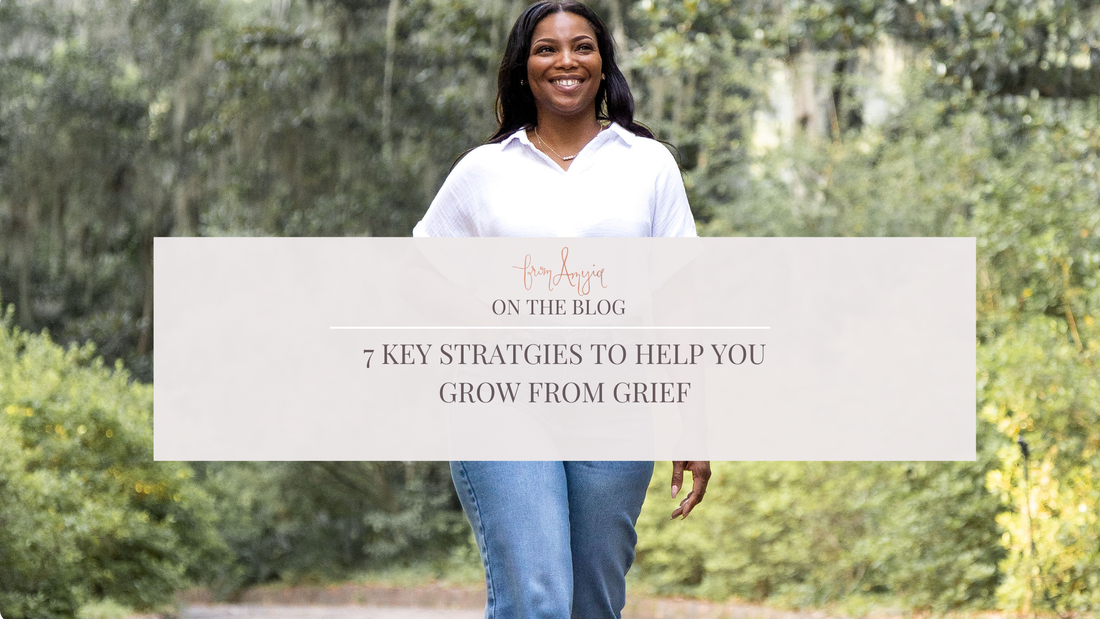 Grief is a deeply painful and personal life experience. When you experience a loss, we experience various complex emotions and traumas. However, like any painful life experience, we can undergo healing and personal growth if we make the decision to journey through the loss. In this blog, I will provide 7 key strategies to help you overcome the impact of grief and grow personally.
Strategy #1. Allowing Yourself to Grieve: Acknowledge your emotions and understand that grief is a natural response to loss. Give yourself permission to feel sadness, anger, and other emotions. Strategy #2. Seeking Support: Reach out to friends, family, or a therapist for emotional support. Talking about your feelings can help you process them. Strategy #3. Self-Care: Prioritize self-care to maintain your physical and emotional well-being. This includes getting enough rest, eating healthily, and engaging in activities you enjoy. Strategy #4. Honoring Memories: Celebrate the life and memories of the person you've lost through rituals or creating a memorial that's meaningful to you. Startegy #5. Acceptance: Over time, work toward accepting the reality of your loss. This doesn't mean forgetting, but rather finding a way to assimilate the loss into your life. Strategy #6. Personal Growth: Grief can lead to personal growth and a deeper understanding of yourself. It can prompt you to reassess priorities, values, and life goals. Strategy #7. Time and Patience: Healing from grief is not linear, and there's no fixed timeline. Be patient with yourself and allow the process to unfold naturally. Remember that everyone's grief journey is unique, and it's okay to seek professional help if you're struggling to cope. Healing and growth are possible, even in the midst of profound loss.  The only cure to grief is to grieve. -Earl Grollman Dealing with grief can be a personal and challenging emotional process. It's important to remember that grief is a normal and natural response to a loss, and as human beings, we all have very different ways of grieving and coping with loss. In today’s blog, I have provided seven strategies that may help you cope with grief: Strategy #1. Allow Yourself to Grieve: Giving yourself permission to experience the full range of emotions that come with grief is essential. Don't try to suppress or deny your feelings, as it's a natural and necessary part of healing. Strategy #2. Seek Support: Talk about your feelings to your close friends, family, or a support group. A healthy support system can provide comfort and understanding during your grief journey. Strategy #3. Express Your Emotions: Find healthy outlets for your emotions, such as journaling, creating art, or engaging in physical activities like exercise. Expressing your feelings can help you process them. Strategy #4. Practice Self-Care: Take care of yourself physically, emotionally, and mentally. This means getting the proper sleep, eating well, and engaging in activities that bring you joy. Strategy #5. Be Patient with Yourself: Grief takes time, and healing is a gradual process. Be patient and compassionate with yourself as you navigate through it. Strategy #6. Seek Professional Help: If life becomes extremely challenging, and you find it difficult to cope with grief on your own. It is imperative to seek professional grief counseling. Speaking to a counselor or therapist can assist you with navigating through the grieving process using strategies tailored to your needs. Strategy #7. Avoid Major Life Changes: Avoid making significant life decisions immediately after a loss because grief can cloud your judgment. Give yourself time before making big life choices or changes. Remember that there is no right or wrong way to grieve, and everyone's journey is unique. Give yourself the time and space you need, and don't hesitate to seek help if you feel overwhelmed.
 “Successful people do consistently what others occasionally do.” -Craig Groeschel, Pastor-Author-Speaker This quote has helped me remember that if I want to be successful, I must do the challenging task of remaining consistent in my work, even when the work does not yield immediate results. I want to share a story with you. In 2021, I received two beautiful orchids from my employees on bosses' day. I love orchids. However, I’ve never consistently cared for and watered my plants, so I’ve always admired them from afar. The gesture of presenting me with these flowers was beautiful. However, I was worried about taking care of them. Both orchids were in full bloom, and the flower buds were the beautiful colors of purple and the other yellow. Over time, I neglected to take care of them. I would consistently say I would water the plants weekly, but when it was time to water both plants, I would delay the task to the next day, and, over time, the plants never got watered. Putting off watering my beautiful orchids caused all the blooming buds to wither and fall off, and soon they no longer produced buds. In late 2022, I observed both plants and considered throwing them away. I told myself, “I’m not good at caring for plants, and there is no use trying to salvage them,” I thought The roots were probably dried up and dead anyway. But then I thought, “If I take the time to water and care for them properly, they could produce buds again. At that moment, I decided to keep both orchids and promised myself I would water them consistently, on the same day at the same time weekly. I then placed a weekly reminder on my phone to help me remember when to water my plants. For months, I saw no progress. The plants produced no signs that the effort I was putting in yielded any results. And I wondered if my plants would ever bloom again. Should I give up and stop trying to work on something that no longer has life? But I remembered the promise and continued to care for the orchids month after month. I even started "positively" speaking to my plants (don't act like you’ve never done it), encouraging them that they could and would bloom again. After six long months of consistently watering, caring, and talking to my plants, I walked into my office one morning and noticed that one of the orchids was starting to bud again. My consistent work was beginning to pay off. Soon, more buds started producing, and one of the orchids was in full bloom. The other orchid soon began to grow as well. After months of not seeing any progress or success, the manifestation of my consistent, diligent work was starting to pay off. Why am I sharing this story with you? To demonstrate that consistent work produces a harvest. Sometimes, we give up on our work prematurely because we don't see immediate results from our hard work. We may not get the likes on the social media content we worked hard to produce. We may need more clients for our new business, or we started working out and eating healthy, but we are not seeing a change in our physical health, so we give up and stop working. I want to encourage you today that even though we may not see immediate results, we must consistently show up for ourselves and our businesses. Over time, we can reap a harvest. Here are some helpful tips to help you stay consistent: #1. Set clear and concise goals. Create your goals using the SMART system. Make the goal(s) specific, measurable, attainable, relevant, and time-abounding. For example, if your goal is to lose weight, include the number of pounds you want to lose, along with a reasonable timeframe to lose the weight, and have someone hold you accountable. Clarifying your goal(s) will make it easier to hit your mark. #2. Establish a routine. Integrate your goals into a daily or weekly schedule. Use tools such as a calendar or planner. Merging your goals into your daily or weekly routine will help you stay consistent and build new habits. Recall the story I shared about watering my orchids and how I immediately set a reminder on my phone to assist me in remembering to water my plants. Also, we all have bad days, so if you miss a deadline, don't give up; just try again the next day. #3. Stay Motivated. When you don't see immediate results, it can be discouraging to keep going. However, to keep yourself on track, find sources of inspiration to keep you motivated. This can be following an influencer you admire on social media or listening to a podcast. #4. Celebrate the small wins. Regularly assess your small successes and celebrate yourself. Making lifestyle changes is difficult, especially when they yield immediate results. Celebrating small victories can keep you motivated and inspired. As we develop new habits, we must become lovers of the process because the fruit of consistency takes time. When we don't see immediate results, we can lose courage and talk ourselves out of continuing the work. But as Galatians 6:9 NIV reads, Let us not become weary in doing good, for at the appropriate time we will reap a harvest if we do not give up. You never know how close you are to receiving your breakthrough. Even when you find it challenging to keep going, I want you to know that you are closer than you realize. Don’t give up on yourself; I hope this blog inspires and encourages you to keep going.
 Procrastination is a thief that steals from your destiny and causes you to miss out on divine opportunities and appointments. Stop putting off for tomorrow what you can accomplish today. -Bishop Rosie S. O’Neal I have struggled with the behavioral pattern of procrastination for most of my life. I have put off completing projects, tasks, and goals, assuming that by delaying them, I would naively get to them tomorrow. However, when tomorrow would arrive, I repeated the same pattern: tomorrow would be next week, next week would be next month, and next month would be another year. After putting my goals and tasks off for so long, I would experience guilt, regret, and sorrow, lamenting over what I could've done differently. I would then promise myself in the new year that I would accomplish my goals. But not long after, the new year would begin, and I would return to my old habits and repeat the same cycle. I grew tired of this unhealthy behavioral pattern at the beginning of this year. I no longer wanted to identify myself with this unhealthy pattern of behavior. I set out to improve by discovering why I allowed procrastination to rob me of accomplishing my purpose. But this time, I needed to create a strategy and develop a plan to help me break the cycle of procrastination. First, I had to be vulnerable and open to different perspectives to help overcome the heavy weight of procrastination. Before I begin to unpack why I procrastinate, I want to define the word. According to the Merriam-Webster Dictionary, procrastination is putting off intentionally and habitually or something I know should be done. After taking the time to understand the meaning, I uncovered four culprits: (1) Fear of criticism, (2) Fear of success, (3) A lack of discipline, and (4) The desire for perfectionism. Let's unpack the meaning of each, and I'll later explain my plan to overcome them. #1 Fear of Criticism. Fear of man will prove to be a snare, but whoever trusts in the Lord is kept safe. Proverbs 29:25 NIV Admitting this was difficult, but I feared people’s criticism, what they thought of me, and possible ridicule. As I discovered my why, I began to understand that I was more concerned about what other people thought and said about me than what God said about me. While talking with a friend, I was transparent and vulnerable about why I was stalling on my second book. My friend listened to me but gave me some great words of wisdom. They informed me that people working on their gifts have no time to criticize or gossip about others. It's the people who are not contributing to their purpose who have the time to talk about others. Being worried or concerned about what other people will say only hurts me and those connected to the mission and my assignment. My fear of others was a snare, delaying me from completing my assignment. #2 & #3 Fear of Success and a Lack of Discipline “Discipline is training expected to produce a specific character or pattern of behavior.” I also discovered that I feared success due to a lack of discipline. If I succeed, I must put all my efforts into doing good work and excelling, which requires changing and developing the discipline. Though I respect structure and organization, I want to do what I want. And at times, all I want to do is binge-watch a Netflix series or mindlessly scroll through social media. I don't want to spend my weekends or evenings planning better ways of being effective in business or developing habits to be more productive. But, in the long run, binge-watching a Netflix series doesn't push the mission forward, and by delaying tasks, I add to my current workload, which adds more stress to my day. #4 I desired perfectionism. Whoever watches the wind will not plant; whoever looks at the clouds will not reap. Ecclesiastes 11:4 NIV Whenever I create, I prefer to have things in a particular way. I don't want to feel fear when I start. I want everthing to be in the right spirit and to have an atmosphere set up for success, with minimal disruptions or distractions. That’s not how life works, sometimes, I have to do it afraid, and walk into purpose despite the feeling of fear. I may have an occasion where everything is how I perfer it, but the chances of that occurring are slim to none. There is no such thing as a perfect time, and standing still delays me even further. I had to accept that there would be inconveniences. One day, I listened to a Youtube video from Myron Golden, and he said disruption always follows intention. He explained that when we set our intention to do something, disruption will always follow. That’s why watching the wind and waiting for situations and circumstances to be perfect is a waste of time. Overcoming Procrastination Whatever your hand finds to do, do it with all your might, for the realm of the dead, where you are going, there is neither working nor planning nor knowledge nor wisdom. Ecclesiastes 9:10 NIV To overcome procrastination, I discovered the need to create a strategy to assist with creating new habits. To start, I looked up the antonyms for procrastination and found eagerness, determination, certainty, and confidence, to name a few. These four words are the words I actively need to use in place of procrastination. Instead of saying I am a procrastinator, I begin by replacing words like I am eager, determined, certain, and confident. I was ready to accept that God did not create me to tie my identity to a bad habit. The next strategy is action. I must create a purposeful working atmosphere and remember that this is only a season. Writing a book, marketing the book, and creating content and tools are hard. However, it's only for a season. Finally, I created a strategy for support. I don't like sharing my struggles with others; however, I wouldn't have gotten that great advice if I hadn't been vulnerable with my friend. My tribe is not only there for support but also accountability. Because I've struggled to overcome this behavioral pattern for so long, I need a group of people to ensure I stay on track. Procrastination can be a habit that leaves us stagnant and stuck and only adds to the long list of tasks we already have to do. Though it can be a difficult habit to break, it's not impossible, and by understanding why we procrastinate, we can create strategies and new practices to overcome it. In time, we will witness tremendous growth and improvement that will develop our character. Let's start to move out of the habit of saying: “I'll do it later,” to actively saying, “I'm going to do this now."
 As we encounter loss throughout life, we can find it challenging to go through the grief process and cope with our loss. Enduring the pain of deep sorrow and understanding the various emotions is complicated. Culture teaches us how to attain and what to do when we succeed, but culture doesn't teach us what to do when we lose or experience grief. Because many of us are unaware of the process, we may suppress our pain or ignore the grieving process altogether. However, delaying the process will only compound our grief and cause more emotional pain. Here, we list six essential strategies to help you navigate and cope with grief and loss. First, discover your “why.” Finding why is an essential part of the journey because, throughout the grieving process, you will have moments where you will want to give up on the process entirely. Grieving can be physically, mentally, and emotionally exhausting. And when you begin to face difficulties, you will want to recall the reason you started the process in the first place. Your “why” could be to live a more fulfilled, healthy life for yourself or your children if you have them. Whatever your why is, be sure to write it down and have it somewhere handy where you can read it often. Second, Give yourself permission to grieve. Grief is a challenging mixture of emotional and mental struggles, and going through the process will also have its challenges. Permitting yourself means accepting everything that comes along with the grieving process. In the beginning, the process will feel uncomfortable, and you may experience moments where you don't believe you are strong enough to endure the journey. However, there is nothing uncommon about grieving a loss. Grieving is a normal and natural process of loss; however, parts of the grieving process will be ugly. As you permit yourself to go through the process, you must accept that there will be moments of deep pain, sadness, and weeping. Regarding grief, there is no one size fits all method, and what may have worked for someone else may not work for you. As you overcome the different challenges you will experience throughout the process, you will notice yourself becoming more emotionally and mentally vital to continue the journey. Third, Lean on Others for Help. Community is an integral part of the journey, so instead of isolating yourself from others, allow your community to support you. When we experience tragedy and loss, we want to separate ourselves from those who love us. Grieving requires vulnerability, even if you have a history of isolating yourself from others and not expressing certain emotions. During times of loss, it is not the time to be alone. We should not do life alone; we need a robust and supportive community to help us overcome life's challenging moments and celebrate life’s greatest moments. Share your favorite stories of the person you lost. Be vulnerable, cry and allow your community to care for you as you journey through grief. Fourth, Embrace Your Faith. Faith during the grieving process means believing that by trusting in God, acting on His principles, and developing healthy coping strategies, you will overcome grief, and grief will not overcome you. When we face difficulties, it is not uncommon to question God; however, asking God questions and accusing God of creating pain are two different things. Many times, we will want to walk away from our faith. When life takes an unexpected turn in the opposite direction of where we thought we were going, there can come a time when we question God. For example, why would He allow this to happen if God is so good? Or, if God loved me, why am I experiencing this type of pain? But, God never promised us a life free of trouble (John 16:33). But Jesus says when we have problems to take heart because He has overcome the world! As we develop a closer relationship with God, we can discover the principles of living a life of peace and joy even during deep pain. Fifth, Seek out a Good Counselor or Grief Coach. It's important to understand that your counselor or coach is your advocate. As the experts, they will help you navigate forward in your grief journey. They can help you deal with triggers and feelings of being stuck. Therefore, seeking professional services such as a grief counselor or a grief coach can help you attain the tools and resources needed that will help you navigate through the process effectively. A counselor or a coach can help you journey through the past without getting stuck, and a coach will help you to build a new future after the loss. Sixth, Grieve to grow. Grieving to grow is a concept I developed after my grieving process. I realized that after the sudden loss of my daughter, my life was not the same as I journeyed through the grieving process. Grief can have a negative impact on how you live life after loss. Grief affects your thoughts, which will affect your attitude and lead to developing negative habits and behavioral patterns. As you cope and heal from your loss, you can grow personally by developing healthy mental and emotional strategies. You will discover you are becoming more assertive, better, and different as you grieve. Since loss is not a one-time event, you can use what you've learned when grief happens again. The tools and wisdom you've gained will help you build a better life, personally and spiritually. Shayna Acree |
|



 RSS Feed